


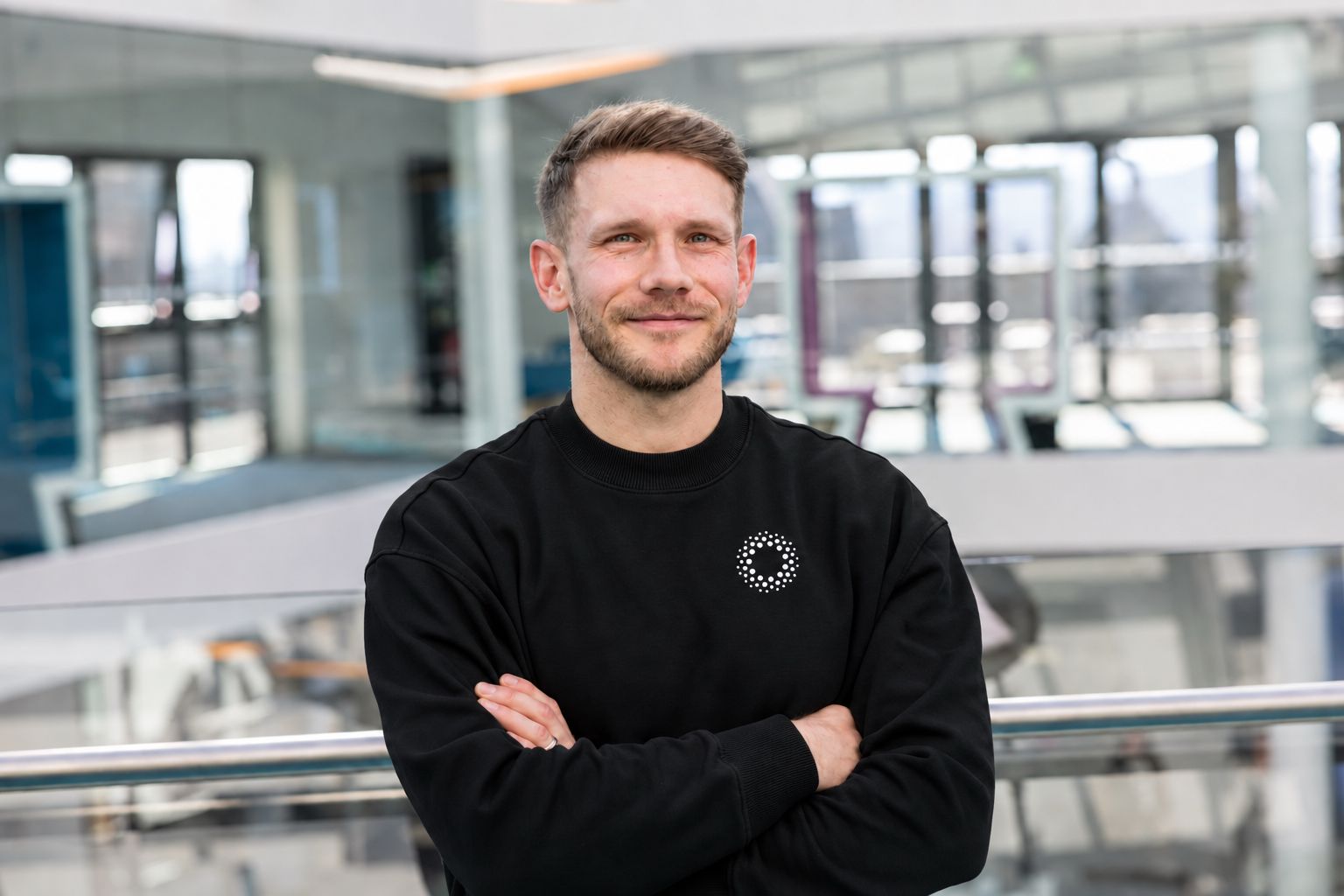
Jeremy McConnell
From addiction to the Elite 15: a Hyrox athlete on loss, recovery and the 1% that makes the difference.

Jeremy McConnell doesn't talk about Hyrox like a hobby. For him, the sport, eight 1km runs broken up by stations of functional fitness, is the structure around which a hard-won life now turns. "It's the thought of ever going back to them places," he says of the years he spent battling addiction. "When I'm on a bad day, I'm not going back there. That gives me the power to train."
He found Hyrox through his local gym. The lads there competed first, and Jeremy followed. What hooked him was the honesty of it: every result laid bare, every weakness measurable, every session a chance to be a fraction better than the last. Three years into serious training, he now races in the Elite 15 doubles, with his sights set on doing the same in the singles.
An honest story
Jeremy has never hidden where he came from. He has lost his mum, his brother, his sister and his dad, and his father, he says, mainly saw him at his worst, in the grip of addiction. He has turned down sponsors who wanted him to present a tidier version of himself. "I'm fully authentic in my approach and speaking about my past to help others," he says. "Showing is better than telling." When he walks out onto the elite stage, the first thing he does is point to his dad and the rest of his family. "I wish they could see me now."
That refusal to perform a sanitised version of himself runs through everything. He would rather answer the hard questions honestly than be "vanilla", and he asks only that people meet change with the same energy they once spent on judgement.
What Hyrox demands
The physical demands are unforgiving. Hyrox asks for a huge aerobic engine, the strength to drag sleds and throw wall balls, and the mental resilience to sit on a bike for three hours and keep going. Jeremy builds his year in blocks: long aerobic and strength work to lay the base, a threshold phase where "the race is really ran", then a sharp two to three weeks of race-specific redlining and mental preparation. The legs, he says, carry everything. The sacrifices, missed parties, birthdays and dinner reservations, he counts as a blessing in disguise.
At the very top, though, he believes the gap isn't training hours. "It comes down to mental strength. It comes down to them 1%." That 1% is what you do first thing in the morning, how you eat, and how you recover. "These are the percentages that give you them seconds at the end of a race."
Where Oxydise comes in
Jeremy first came across Oxydise on social media while looking for "the smallest way to improve". He already knew athletes using hyperbaric therapy, and after dealing with Alan and the team, "they were just gentlemen", he was sold. Before Oxydise, he says, he trained through constant niggles and DOMS that took days to clear. With the hyperbaric chamber, "my recovery was sped up enormously. I couldn't imagine not using it."
His routine now leans on two tools. The H-Bot, the hyperbaric oxygen chamber, he uses on hard days, a couple of hours after a tough session. "If I do a hard session and I hit the H-Bot, I feel fantastic straight after it." He has noticed his endurance climb with continuous use, and his focus and willingness to train rise with it. The red light therapy he saves for the mornings. "The red light, it brings down inflammation. It just makes me feel brand new."
He is blunt about how much it matters. "These are part of my routine and I'd be lost without them." He will go further: for an athlete training the hours he does, rest days are more important than hard days, because that is where the body actually adapts.
The road ahead
Jeremy is the first to say he is not the finished article. Three years into serious training, he feels he has years of improvement ahead. The goal is simple and stubborn: keep pushing, get back into the Elite 15 in the singles, and keep proving the doubters wrong. "People laughed at me when I was sitting on a park bench full of vodka." Few are laughing now.


